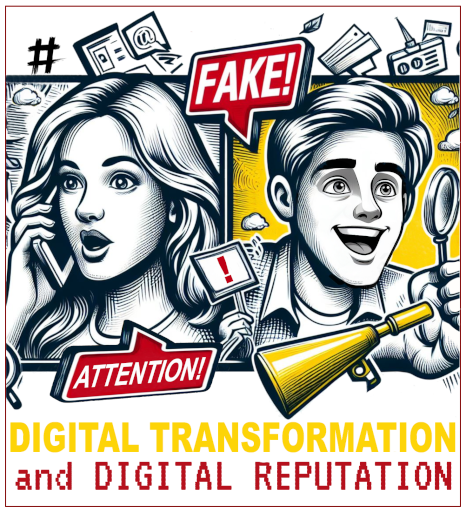

Digital transformation and digital reputation

Objectives:

  • Make students understand the importance of digital transformation
  • Create awareness on the issue of the impact of fake news on students that generates a reconnaissance in the member countries involved in the partnership
  • Identify the distinctive elements of effective training to face the digital transition
  • Draw attention to a critical issue of our times: information poised between the right of expression and the dissemination of false information that can damage people’s image and reputation
  • Highlight its impact both from a social and economic point of view, putting the lives of children at risk
  • Investing in the training of students in terms of communicative, psychological and sociological skills
  • Offer schools a model for raising awareness of digital and social reputation


Implementation:

To achieve its objectives, the project includes production and training activities.
The production activities consist of the creation of the Training Toolkit, the training materials for the teacher trainers and the E-Learning Course for the students.
The training activities include a training programme for teacher trainers and pilot hybrid training courses (e-learning and laboratory) for students, which take place in the three participating countries: Italy, Poland and Romania.

The training will touch areas related to:

  • Personal branding, represented by that set of content that young people publish online and that tells their own person and their person. Students must understand that using them to the fullest means getting good publicity;
  • Digital reputation, i.e. the image that everyone builds on the web, through the sharing of material and discussions on forums, blogs and more recently on Social Networks. It is a territory in which many venture without really realizing what they are facing;
  • Taking care of digital reputation, i.e. keeping in mind key steps to maintain a positive online reputation on social media.


Results:

The project includes

  • the creation of the “Digital transformation and digital reputation” Portal, in which the results of the project will be disseminated,
  • the creation of the online training platform,
  • the creation of a community of practice and online learning for students who intend to deepen the aspects of digital transformation and above all the ways in which to defend their person on the web, both in terms of image and in terms of news learned;
  • the creation of innovative training/learning tools;
  • the involvement of opinion leaders belonging to the three European countries, who can hold webinars or asynchronous lessons within the community of practice and learning;
  • the creation of the Handbook “Digital transformation and digital reputation” in English, Italian, Polish and Romanian.


Partner involvement:
The partners will collaborate in carrying out all project activities.

Specifically:

  • The Fondazione  will take care of project management and dissemination activities. It will support production activities, giving all the necessary parameters for the preparation and implementation of training materials.

He will be asked to create a training module of the e-learning course and to create the related in-depth materials.

It will support the creation of the community of practice and online learning.

It will try to involve some Italian schools in experimentation and monitoring activities.

  • LIM will take care of the technical activities of creating the portal, the community of practice and online learning and the e-learning platform.

He will be called upon to perform the post-production of all the materials that will be uploaded to the e-learning platform.

  • Recdate will be responsible for creating the tools for the initial, ongoing and final monitoring and evaluation of both the teacher trainer target and the student target. It will try to involve some Romanian schools in experimentation and monitoring activities.

He will be asked to create a training module of the e-learning course and to create the related in-depth materials.

It will support the animation of the portal and the community of practice and learning.

  • Zespol Szkol will be responsible for giving the didactic and pedagogical inputs to the structure of the e-learning course. He will be asked to create a training module of the e-learning course and to create the related in-depth materials. It will provide a group of students from its school to be involved in the experimentation and monitoring activities.